





News.
Miss Lambe from Jane Austen’s unfinished novel ‘Sanditon’ brought to life by artist Lela Harris
29th July 2025

Harewood House Trust presents: ‘Austen and Turner: A Country House Encounter’, a landmark exhibition marking the 250th anniversaries of novelist Jane Austen (1775–1817) and artist J.M.W. Turner (1775–1851). The exhibition is co-curated by Jennie Batchelor, Marjorie Coughlan, Richard Johns and Chloe Wigston Smith from the University of York, working with Rebecca Burton, curator and archivist at Harewood House, and independent curators Jade Foster and Diane Howse. For the first time, the exhibition brings together the literary and visual worlds of two of Britain’s most celebrated cultural figures, within the historic setting of Harewood House.
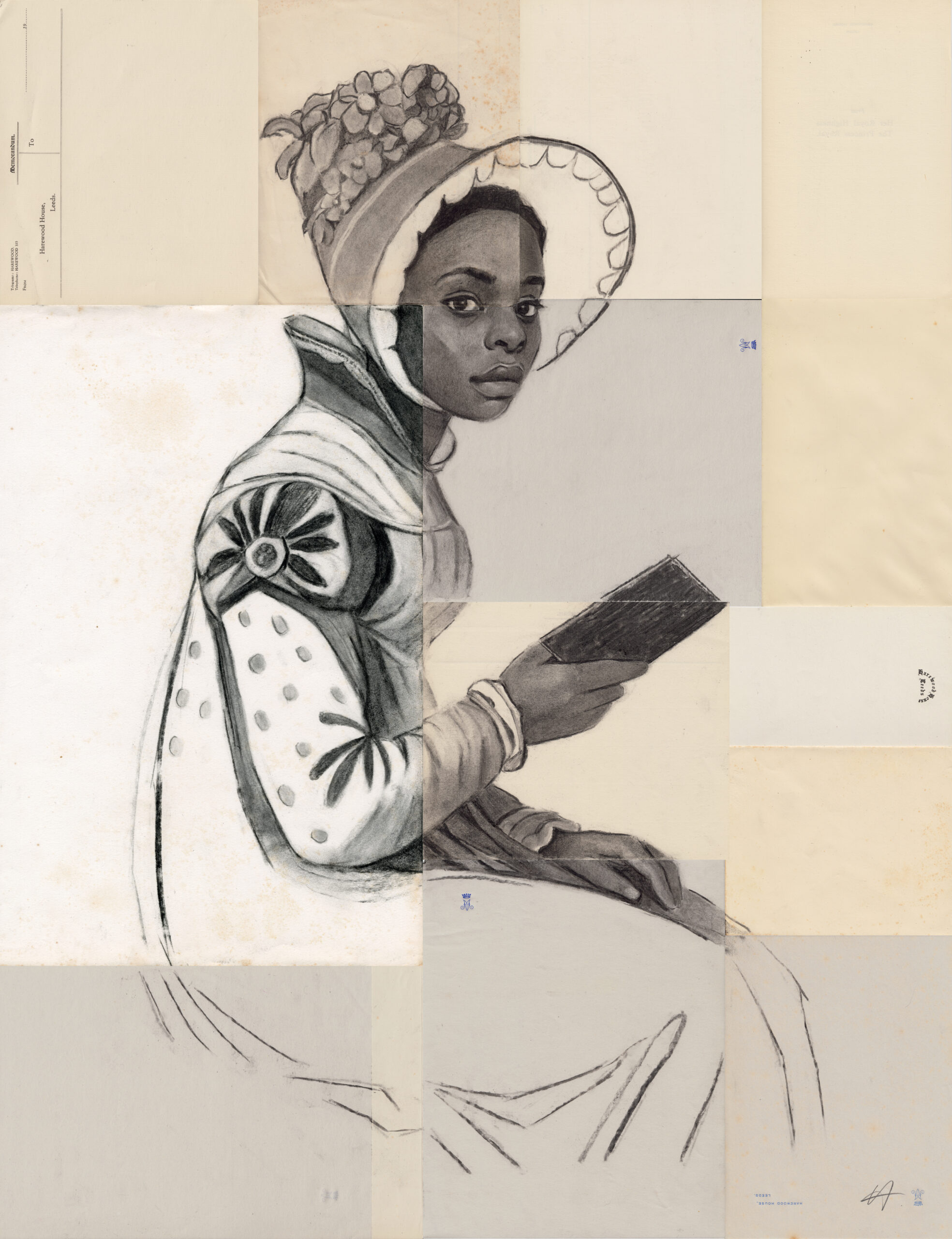
As part of the exhibition, the Trust is proud to unveil a major new portrait commission by contemporary visual artist Lela Harris, known for her sensitive and powerful depictions of figures who have often been overlooked or marginalised by history. Harris has created a compelling new portrait of Miss Lambe, the only character of African heritage in Austen’s novels, from her unfinished manuscript ‘Sanditon’, which is also on display as part of the exhibition.
Miss Lambe is unique in Austen’s writing: a young, wealthy heiress of African heritage who had a ‘maid of her own’ and ‘was always of the first consequence in every plan’. Her great fortune tempts unscrupulous characters to imagine acquiring her wealth through marriage.
Harris’s portrait of Miss Lambe remains unfinished, echoing both the unfinished nature of ‘Sanditon’ as well as highlighting the historic erasure of women of colour from archival spaces. Detail is concentrated in Miss Lambe’s face and hands, giving Austen’s character life, whilst incomplete areas of clothing reflect the sitter’s untold narrative. Like Austen’s handwritten manuscript, Harris’s technical adjustments can be seen in these unfinished areas.
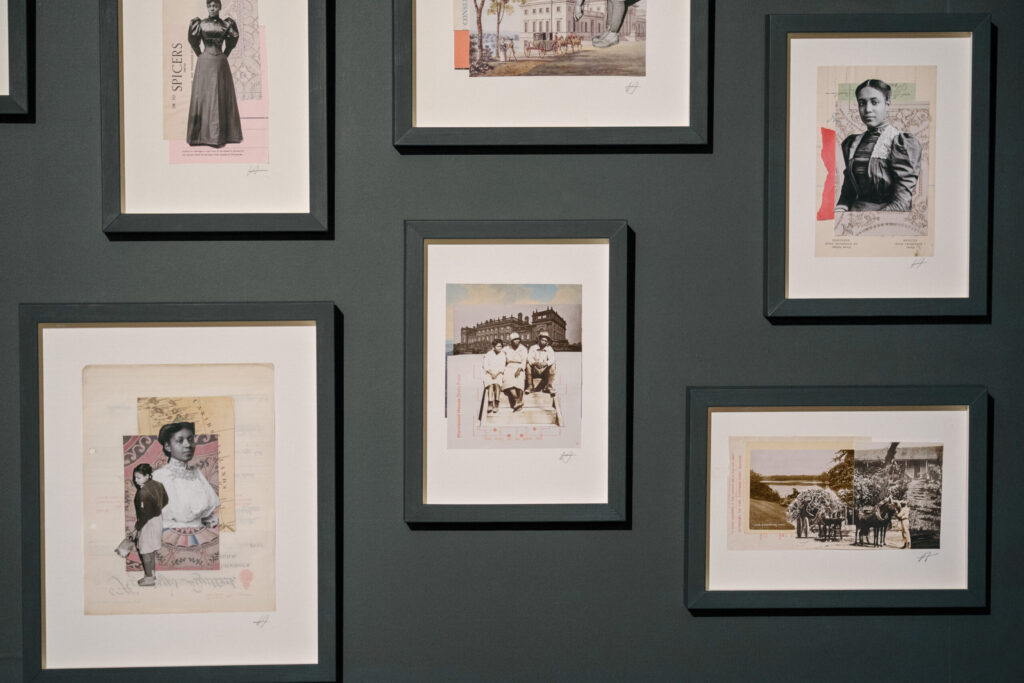
The portrait’s picture surface has been pieced together using 20th-century stationery from Harewood House. In her preparatory work for this portrait, Harris used the technique of collage to build a picture of Miss Lambe beyond Austen’s unfinished manuscript, imagining the character within the context of Harewood and its complex histories and collections. Through this portrait, Harris bridges the gap between fact, fiction and historical imagination.
Harris’s portrait sits alongside new work by the award-winning poet and performer, Dr Rommi Smith, Harewood’s Writer in Residence for the duration of the exhibition. Through experimentation with poetic form and composition, as well as her research into the life and work of Austen and Turner, Smith has begun a series of new poems responding to the historic material and themes of the show. The first two poems in the series are specially printed for display in collaboration with Thin Ice Press, at the University of York. Smith has also co-facilitated a series of public-facing creative workshops, in collaboration with musician and composer Christella Litras, inviting audiences to fuse their written responses to the exhibition with music. Smith’s residency will culminate on the 4th of October 2025, with a live performance at Harewood. During the event, attendees from the workshop series will perform alongside Smith, who will share the writing produced during her residency, in collaboration with Litras.
Lela Harris said: “With this portrait I’ve really indulged my inner Austen fan girl as well as being very inspired by Jennie Batchelor’s collection of 18th-century fashion plates from the ‘Lady’s Magazine’.
When planning the portrait I’d always wanted Miss Lambe to be looking directly at the viewer. Initially I’d contemplated portraying her with a defiant expression but after some reflection and a great discussion with poet and writer Dr Rommi Smith, which centered around Jane Austen’s progressive depiction of Miss Lambe’s frailty and her being a recipient of tenderness, in a wider colonial context of enslavement, where Black people were dehumanised and therefore falsely constructed as less capable of experiencing pain than white Europeans, I very much wanted to embrace the characters fragility and Austen’s description of Miss Lambe as ‘precious, chilly and tender’.
I greatly admire Austen for the way she so casually introduces Miss Lambe into Sandition. There seems to be no fanfare or overemphasis on her ethnicity, especially with regards to her wealth, which is really refreshing, so I’ve tried to integrate this feeling into her portrait. I’ve kept things deliberately simple and unfinished to reflect that we don’t know Miss Lambe’s full story. Being able to use found 20th-century papers from Harewood’s stationery cupboard was a real joy. I think the writing papers help to anchor the drawing in Harewood’s complex colonial history and I very much enjoyed the challenge of working across slightly different surfaces.”
Celebrating the 250th anniversary since their shared birth year with new narratives, ‘Austen and Turner: A Country House Encounter’ is co-curated by Harewood House Trust and the Centre for Eighteenth Century Studies at the University of York, working with independent curators Jade Foster and Diane Howse.
Harewood House, located just north of Leeds, is a classic example of an 18th-century Palladian country house. It was built by Edwin Lascelles, using profits from the transatlantic trade in enslaved African people and associated industries. Harewood’s connections to transatlantic slavery are addressed within the show, alongside an exploration of Austen’s and Turner’s work within their colonial contexts.
Neither Jane Austen nor JMW Turner had aristocratic backgrounds but they both had privileged access to the world of the British country house, whether as a commissioned artist, an invited guest, as tourists or through family connections. Turner’s paintings of Harewood remain some of the most iconic works in Harewood’s collection. As a young, aspiring artist at the very start of his career, he was invited by the Lascelles family to paint the House and its landscape. Nine paintings of the house, castle and its surrounding landscapes remain in the collection and are on display as part of the show.
Harewood provided the springboard for one of the most important sketching trips of Turner’s career, where he discovered his love of landscape and began to push the boundaries of watercolour painting. Austen knew of the Lascelles family at Harewood, suggestively naming a character after them in Mansfield Park (1814), a novel that explores empire and slavery as key themes.
Rebecca Burton, Curator & Archivist at Harewood House Trust says: “We are delighted to be working with Lela Harris to continue Austen and Turner’s tradition of creative innovation here at Harewood; in their 250th anniversary years, there has never been a better time to explore their iconic creative legacies in new and artistic ways.
We are incredibly excited to share Lela’s vivid portrait of Miss Lambe with our visitors. As a visual artist with a strong focus on uncovering hidden narratives, it is significant that Lela has chosen to explore the unfinished story of one of Austen’s most elusive characters, and the only one of African heritage. In a touching portrayal that honours Miss Lambe’s incomplete narrative, Harris skillfully weaves together Austen’s fictional fragments with those of both historical truth and historical imagination, to give the character life. Like Turner’s little-known yet perceptive figurative works, often hastily sketched from life, Miss Lambe is captured in a momentary glance, looking up from the pages of her book.
For both Austen and Turner fans alike, Lela’s portrait offers a tantalising opportunity to witness the very first portrait of Miss Lambe alongside Austen’s own handwritten manuscript where she begins, but sadly never completes, her character’s story.”
Professor Jennie Batchelor, Head and Professor of English at the University of York and a Co-Curator of Austen and Turner, says: “We have waited centuries for an artist to bring Miss Lambe to life and I can’t think of a better tribute than Lela’s stunning, richly textured and tender portrait of the only figure explicitly of African descent in a Jane Austen novel. Part of the inspiration for Miss Lambe’s dress, and attitude comes from a late 1810s fashion plate showing ‘Sea-side Walking Dress’ from the Lady’s Magazine, a magazine we know Jane Austen read. It is fitting that Miss Lambe sits at the seaside resort of ‘Sanditon’ with a book in her hand and I can’t help but wonder what she is reading? It feels even more fitting that she looks directly at the viewer, inviting us to see her as if for the first time. Precious, indeed.”
Harewood will present a Regency season throughout the summer to accompany the exhibition, including Pride and Prejudice outdoor theatre, an extravagant Regency Ball, a candlelit concert and themed afternoon teas. Turner-inspired artist-led painting workshops will be held in the ‘Capability’ Brown landscape, as well as ‘Tiny Turner’ woodland activities for toddlers and free Regency inspired activities for families.
‘Austen and Turner: A Country House Encounter’ is at Harewood House from Friday 2 May to Sunday 19 October 2025. For more information visit https://harewood.org/whats-on/event/jmw-turner-and-jane-austen/