






News.
Two pioneering women’s organisations celebrated in new University of Leeds exhibition
14th January 2025

Crackling with visual invention, DIY spirit and righteous protest, a new exhibition in The University of Leeds’ Treasures of the Brotherton Gallery explores the histories of two pioneering organisations that grew out of the Women’s Liberation Movement of the 1970s: the Women’s Aid Federation of England and Leeds Animation Workshop.
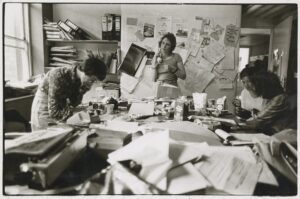
Opening on 14 January 2025, Animated Activism: Women Empowered is a vivid and inspiring account of a half century’s struggle for women’s rights, a celebration of the survival of Women’s Aid and Leeds Animation Workshop to the present day, and a reminder of how much work is still to be done.
Selected from the organisations’ archives, both held in the University’s Cultural Collections, pasted-up newsletters, badges, posters, photographs and animation cels share in – even anticipate – the collage aesthetic of punk. They testify to the energy, wit and passion that these two very different collectives have in common. Exhibits from Feminist Archive North, also held at the University, reveal the sobering context for their work: a backdrop of 1970s and 80s culture saturated with misogyny and violence.
Women’s Aid was formed in 1974 as a national network of independent refuges for women experiencing domestic abuse. An activist collective led by women, it combined practical provisions with a powerful lobbying strategy, leading the push for vital legislation. During the 1980s, Women’s Aid established the first national domestic abuse helpline; in 1999 it launched the first comprehensive domestic abuse website in the UK and The Gold Book, the first UK-wide public directory of refuge and helpline services. Over 50 years Women’s Aid has greatly expanded its services, pioneered research into domestic abuse and continued to campaign for change.
Sharing in Women’s Aid’s grassroots approach and the demand for urgent change, in 1976 a small group of feminists in Leeds came together to make a film about the need for pre-school childcare. Who Needs Nurseries? – We Do! was completed in 1978, and in the same year the group was formally established as Leeds Animation Workshop. In 1982, with a grant from the British Film Institute, it bought the house in Harehills, East Leeds, where it is still based today.
Led by women and concerned with many of the issues campaigned on by Women’s Aid, Leeds Animation Workshop also produces and distributes films on a wide range of intersecting social and educational issues including racism, homophobia and the environmental crisis. Pretend You’ll Survive (1981), for example, skewers the absurdity of the government’s ‘Protect and Survive’ campaign on the nuclear threat with a chastening, darkly funny vision of one woman’s nightmares.
Leeds Animation Workshop’s archive puts it at the heart of Leeds’ radical arts networks, working alongside the likes of Leeds Other Paper, Red Ladder Theatre Company and Pavilion, organising screenings across the city and supporting Leeds Black Film Festival. It also reveals an impressive reach: Alan Bennett voiced a series of films on gender and equal opportunities; other narrators have included Lenny Henry, Michael Rosen, Maureen Lipman and Meera Syal. An original score by free jazz legends Lindsay Cooper and Maggie Nicols accompanies 1983’s Give Us A Smile, a wonderfully fluid hand-drawn animated film revealing the effects of everyday sexism.
Painstakingly hand-painted cels, articulated paper characters used in stop-motion animation, reels of 16mm film, storyboards, scripts and funding proposals show the resourcefulness and range of skills required to make a film before the advent of mobile phones and easy access to digital technology.
Bringing the Leeds Animation Workshop story up to the present, a newly commissioned short film explores the related and separate histories of both organisations, and how their archives came to be at Leeds. Made with support from the Wellcome Trust, it will be screened in the exhibition for the first time.
Holly Smith, Archivist at the University of Leeds Cultural Collections and a co-curator of the exhibition, comments:
“With this exhibition we’re proud to showcase two of the newest additions to the University of Leeds’ Cultural Collections: the archives of Women’s Aid and Leeds Animation Workshop. Each is brimming with bright and colourful creativity, telling stories from the last 50 years of women’s activism in bold and exciting ways. The research potential in these new collections is astounding and we really hope that this exhibition draws attention to the work and legacies of these two organisations.”
Nikki Bradley MBE, Director of Services at Women’s Aid, says:
“As we celebrate 50 years of Women’s Aid, we are proud to be a part of this important exhibition at The University of Leeds. The exhibition gives us the opportunity to look back at the incredible work of our organisation over the last half a century and reflect on just how far we’ve come. As we look to the future, we are determined to continue working to reduce and eradicate domestic abuse. Together, we can create the first generation where domestic abuse no longer exists.”
Terry Wragg, Worker-Director and a founder member of Leeds Animation Workshop, comments:
“When many of us were young, in the 1950s, ’60s and ’70s, they told us women couldn’t be artists or animators. A woman, if she was extremely lucky, might be allowed to trace and paint some of the men’s drawings; or perhaps be secretary to a director. And if you were living in the North there would be no chance at all.
“We’ve donated almost our entire collection of documents and artwork to the University of Leeds archive. The main reason is to provide evidence – so that, in the future, nobody will be able to tell young women from Yorkshire that they can’t make animated films.”
Animated Activism: Women Empowered runs in the Treasures of the Brotherton Gallery, University of Leeds, from 14 January – 20 December 2025. Admission is free and open to all, with no booking required, and the gallery is open from 10am – 5pm, Tuesday – Saturday.
An events programme will include an evening celebration from 5.30pm on Thursday 13 February, with more details to be announced.
Please note that this exhibition deals with themes that some people may find difficult, such as violence against women, sexual assault and domestic abuse. There may also be historic language that some may find sensitive or offensive. If you are personally affected by any of the topics covered in this exhibition, please see the list of resources available online here or at the back of the large print guides available at the exhibition reception.